
Violation tracking and board records built for Texas self-managed HOAs
Replace scattered spreadsheets and email threads with organized case files, notice tracking, and board records — designed around how volunteer boards actually run enforcement, from first observation to resolution.
SubdivisionHQ is onboarded directly by our team — there is no public sign-up.
Self-managed enforcement is hard to keep organized
Most self-managed Texas HOAs run compliance out of whatever tools they already have. That works — until a case turns into a dispute.
Case notes live in email and text threads
Violation history gets scattered across inboxes, texts, and personal notebooks, so nobody has one place to check where a case actually stands.
Inconsistent enforcement creates disputes
Without dates, notices, and follow-ups recorded in one place, similar violations get handled differently — and residents notice.
Notice delivery is hard to prove later
When a case escalates, the board needs to show what was sent, when, and how it was delivered — not rely on memory months later.
Volunteer boards carry the full workload
Self-managed HOAs don't have a management company's back office. Every extra step is unpaid time from a volunteer board member.
Everything a board needs in one system of record
One place for cases, notices, records, and reporting — built specifically for how Texas HOA boards operate.
Violation Case Management
Track observations through resolution with photo evidence, timestamps, and a complete case timeline.
Notice Generation & Delivery Tracking
Generate notices and record delivery method, dates, and recipient acknowledgement in one place.
Compliance Dashboard
Give the board visibility into open cases, aging violations, and hearing requests at a glance.
Hearing Workflow Support
Timing guidance and evidence packets to help keep hearing-related steps organized and on schedule.
Board Records & Acknowledgements
Centralize governing documents and track each board member's acknowledgement of board policy.
Resident & Property Directory
Keep property, lot, and resident contact records current and searchable across the community.
See what your board would actually use
Real screens from the product — cases, notices, fines, and property history, organized the way a Texas self-managed HOA board works through enforcement.
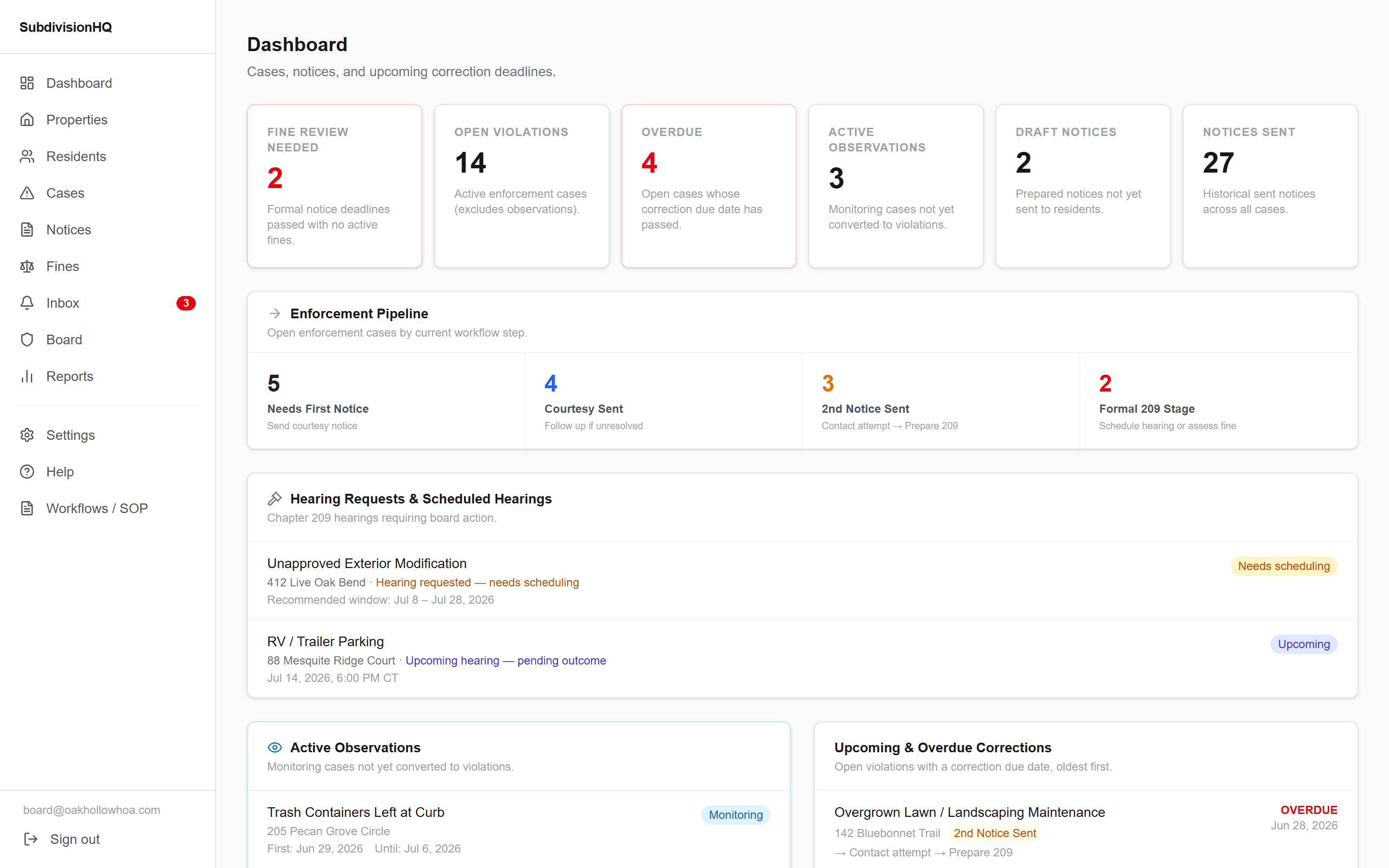
Dashboard
Open cases, overdue corrections, and hearing requests — all in one view for the board.
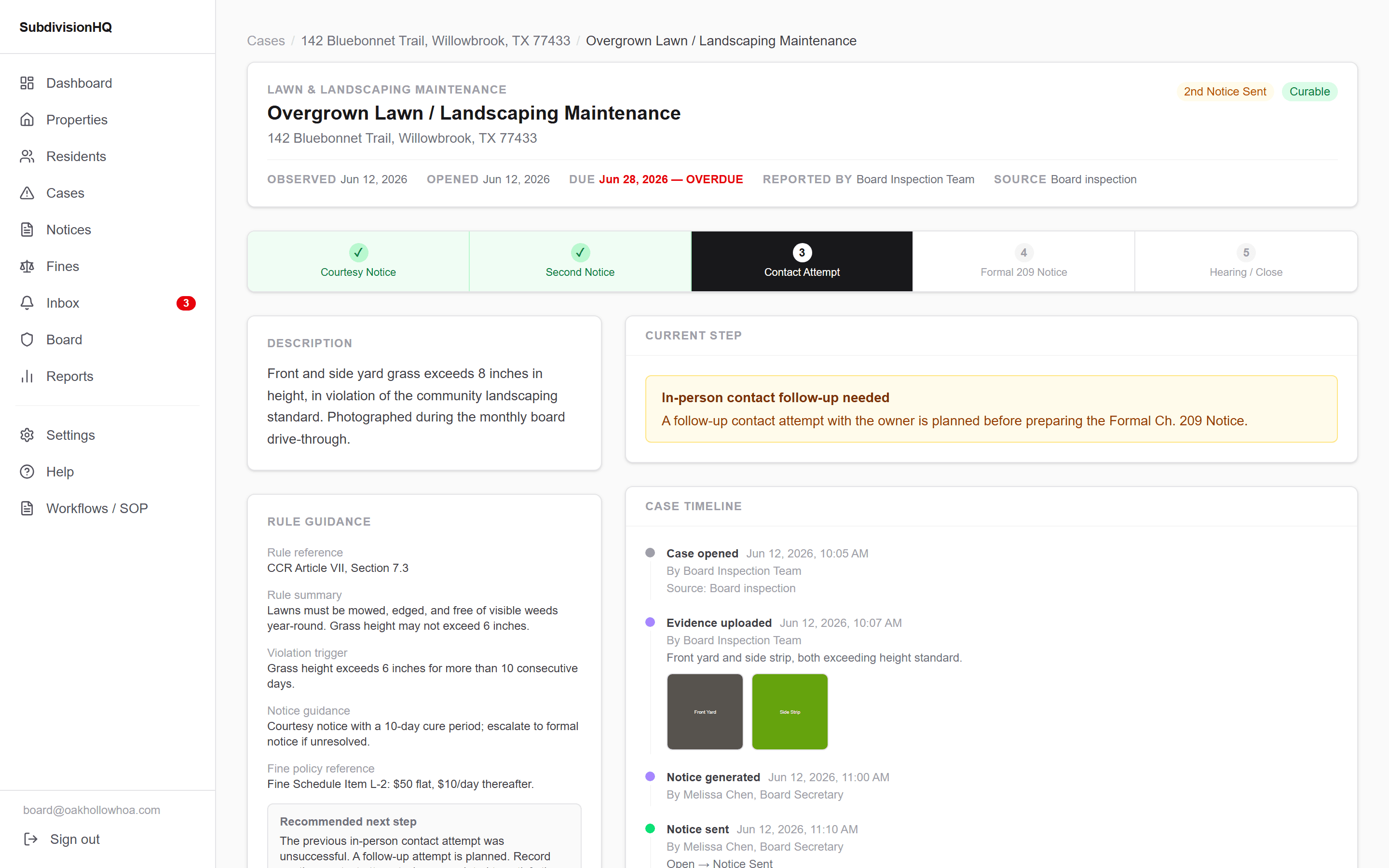
Violation Case File
Every case in one record: photo evidence, rule guidance, and a full timestamped timeline.
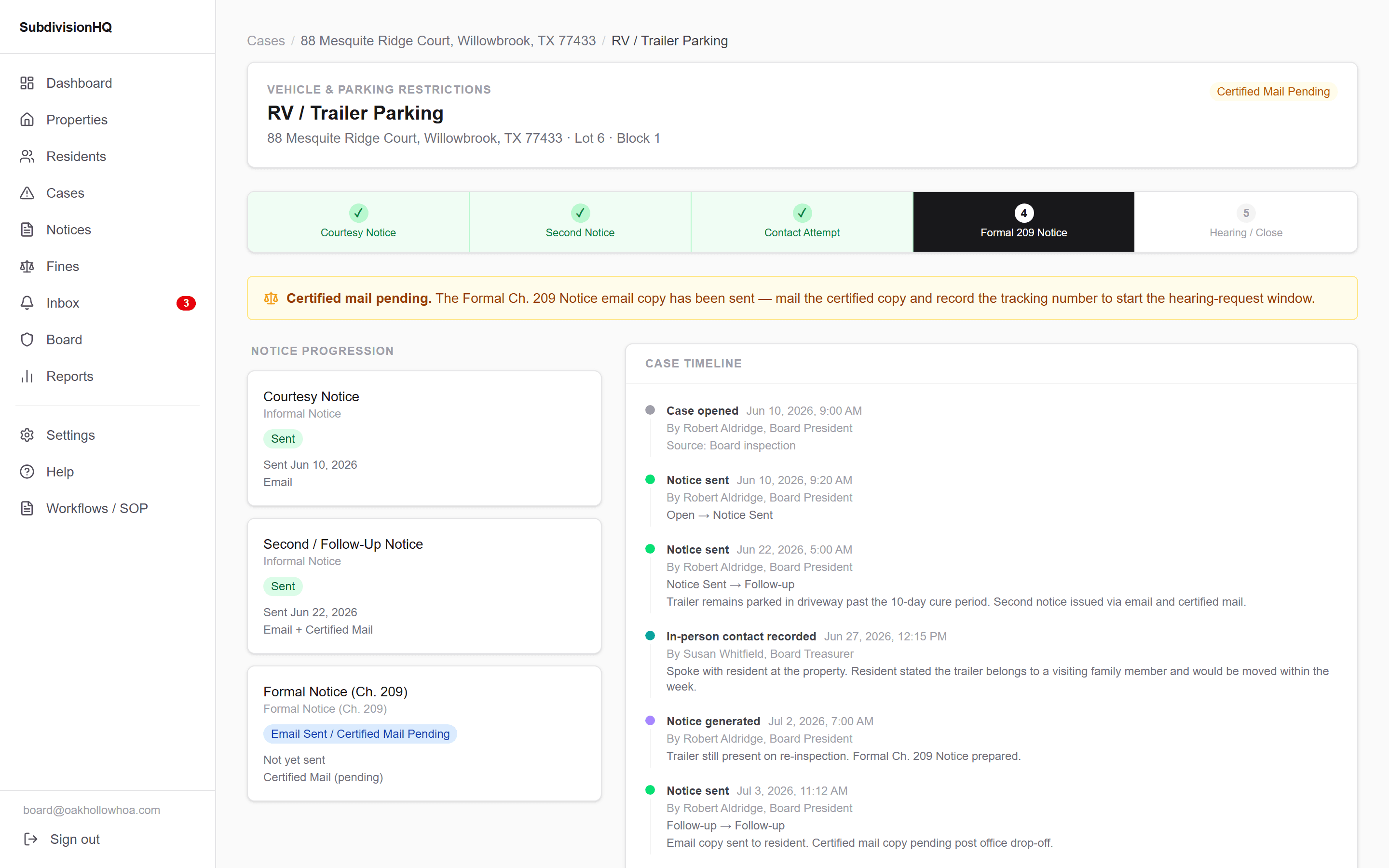
Notice Escalation
Courtesy → second notice → Formal Ch. 209 — each step tracked so nothing gets skipped.
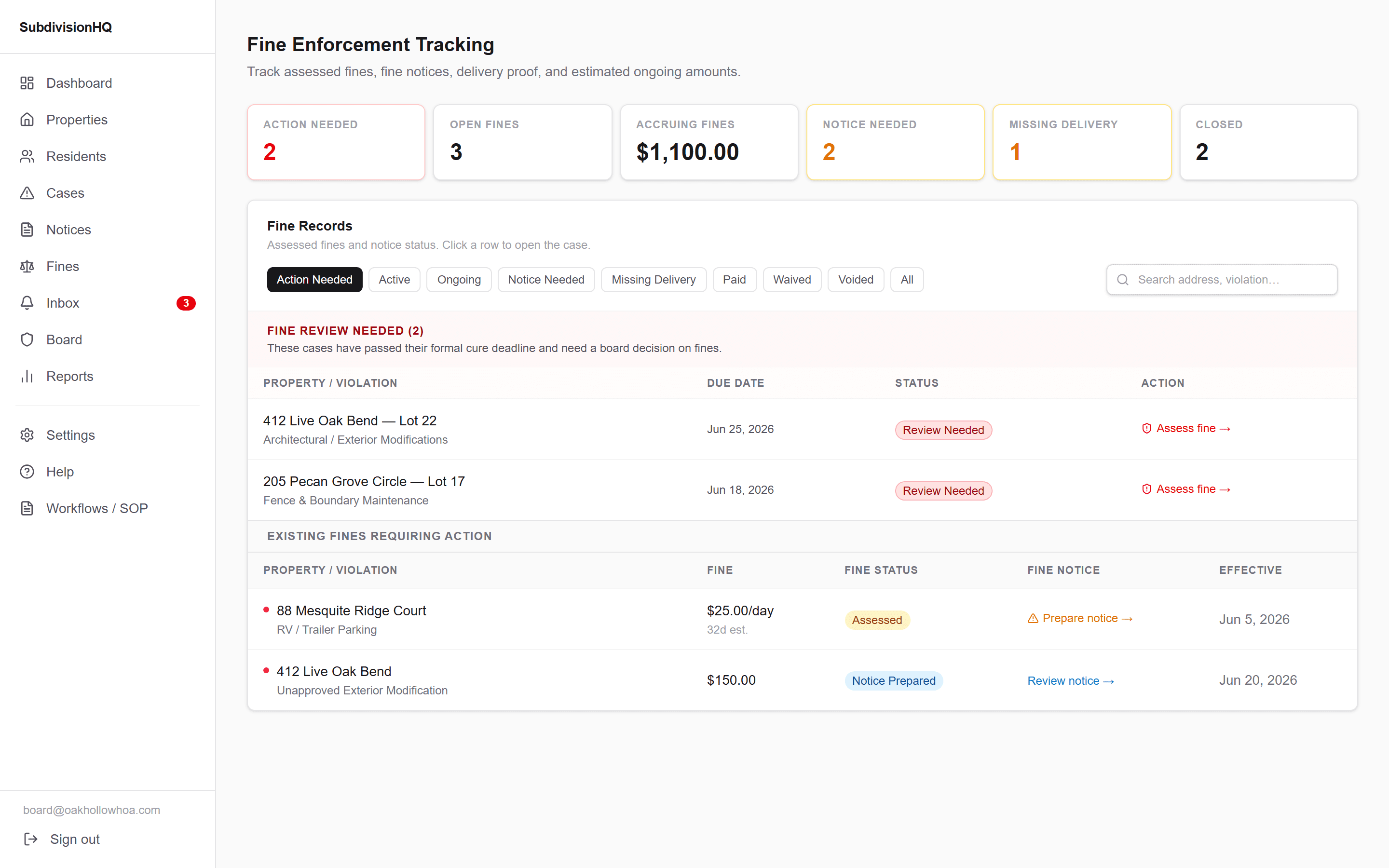
Fine & Chapter 209 Tracking
Assessed fines, notice delivery proof, and estimated ongoing amounts in one table.
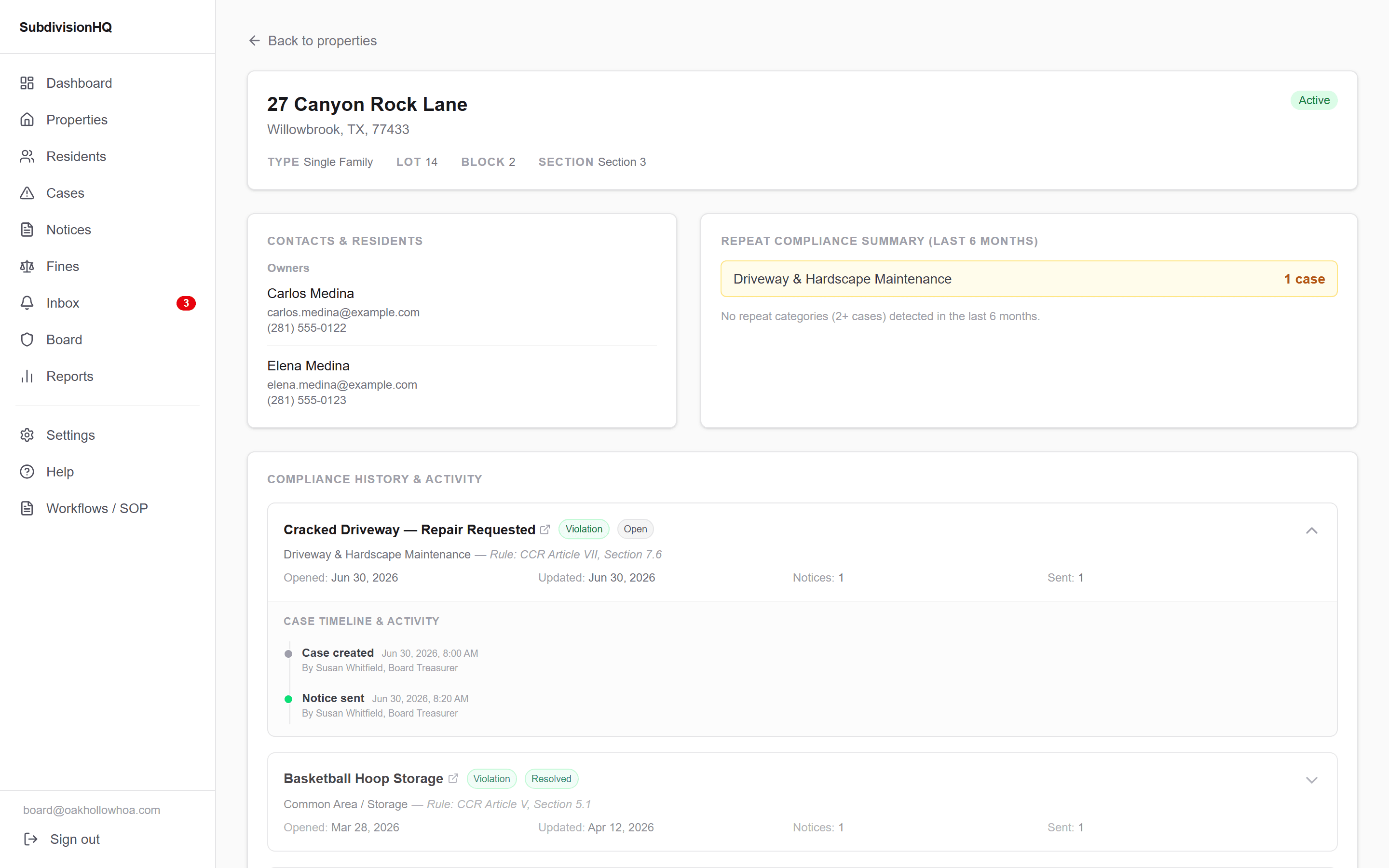
Property Compliance History
Pull up any address and see its full compliance history before deciding next steps.
Built around how Texas HOAs enforce restrictions
Texas Property Code Chapter 209 shapes how homeowners associations must handle notice, cure periods, and hearing requests before assessing fines or pursuing further action. Boards that keep a clear, dated record of each step are in a much stronger position if a case is ever challenged.
SubdivisionHQ supports organized, Chapter 209-friendly workflows — structured notice steps, documented timelines, and a clear case history — so your board can work consistently from case to case.
A note on legal advice
SubdivisionHQ is not a law firm and does not provide legal advice. It does not guarantee compliance with Chapter 209 or any other law. Boards should consult their HOA attorney on compliance questions specific to their community and governing documents.
Onboarding is handled by our team, not a sign-up form
New HOAs are set up directly by SubdivisionHQ after a demo — your board never has to configure the system from scratch.
- 1
Schedule a short demo
We walk through your board's current process and show how it maps onto SubdivisionHQ.
- 2
We configure your organization
Properties, violation categories, and board member accounts are set up for you — there is no self-serve sign-up.
- 3
Board & manager walkthrough
A short working session for whoever will use the system day to day, using your community's real setup.
- 4
Go live
Start logging cases and sending notices with your existing records already in place.
Guides for organized, defensible compliance
Practical guidance for HOA boards on documenting violations, notices, and enforcement records.
How HOA Violation Notices Should Be Documented
A notice that isn't documented is a notice you can't prove you sent. Here's what a defensible record actually looks like.
Courtesy Notice vs. Final Notice: What's the Difference?
Not every violation notice carries the same weight. Understanding the escalation sequence keeps enforcement consistent from case to case.
How to Build a Defensible HOA Compliance Record
A defensible compliance record isn't built in the moment a case is challenged — it's built one documented case at a time, well before that.
See SubdivisionHQ with your own community's cases
Tell us about your HOA and we'll follow up to schedule a demo that walks through how it fits your board's current enforcement process.